The Nordic Africa Podcast
Join us on the Nordic Africa podcast as we talk to political scientists, anthropologists and economists about current issues and trends in Africa. We analyse the choices of African leaders, we challenge dominant narratives about the continent, and occasionally, we look into the crystal ball to see where Africa is headed… Hosts Heba Habib and Henrik Alfredsson and guests guide us toward a deepened understanding of Africa’s role on the global scene.
Listen on:

Episodes

Oct 7, 2026
Oct 7, 2026
22 min
Africa’s global role is set to expand significantly over the next two decades, reshaping the conditions for Europe’s external relations. This policy note explores four plausible futures for Africa–Europe engagement towards 2045, alongside a low-probability but high-impact ‘black swan’ scenario. It argues that Nordic and European policymakers must prepare for a more fragmented, competitive and strategically autonomous Africa while safeguarding multilateral cooperation where possible.

Sep 1, 2026
Sep 1, 2026
18 min
The extraction of critical minerals in Senegal highlights the complex trade-offs between economic growth, environmental sustainability and social equity. Projects like the French-led Eramet Grande Côte (EGC) have led to environmental degradation, threats to livelihoods and community tensions, exacerbated by weak law enforcement and suppressed activism.
This policy note calls for stronger governance, community inclusion and sustainable mining practices.

Sep 1, 2026
Sep 1, 2026
22 min
Since 2021, the Democratic Republic of the Congo (DRC) and Zambia have taken steps towards establishing a regional battery value chain, seeking to move from extraction towards higher-value production such as battery precursors and, ultimately, batteries themselves.
This policy note explores the challenges to a domestic battery industry in DR Congo and Zambia, and the importance of state ownership in the mining sector.

Sep 1, 2026
Sep 1, 2026
19 min
The displacement of people in Africa is increasingly shaped by overlapping crises – a polycrisis – where conflict, climate change and economic shocks amplify one another and strain response systems. While humanitarian needs remain urgent, long-term resilience requires stronger institutions, locally led approaches and coordination.
Drawing on consultations with 20 experts, this policy note identifies key areas for more effective responses, including how Nordic and international actors can support stronger African leadership and context-sensitive solutions.

Sep 1, 2026
Sep 1, 2026
22 min
Sudan’s civil war has evolved into a grinding, increasingly regionalised conflict fuelled by security fragmentation, rival war economies and centre–periphery divides. The Gulf monarchies and neighbouring powers shape the battlefield through arms, finance and diplomatic cover, deepening proxy-war dynamics.
In this Policy Note, researchers Assem Abu-Hatab and Federico Donelli explore three scenarios for how the conflict could develop: a high-likelihood drift toward a de facto split, a possible Gulf-driven return to talks, or a lower-probability military takeover by one of the two warring parties.

May 26, 2026
May 26, 2026
1 hr 40 min
Young, unmarried women from opposition parties or marginalised ethnic groups face the highest risk of electoral violence. Gendered electoral violence includes harassment, intimidation, online abuse and sexual assault. It is structural rather than incidental, shaping who participates in politics and under what conditions.
In this recording, researchers from the Nordic Africa Institute, Diana Højlund Madsen and Shingirai Mtero, together with Mandiedza Parichi, present findings from the book Making Politics Safer: Mitigating Violence Against Women in Politics in Ghana, Kenya and Zimbabwe.
They discuss the factors driving violence against women in politics and highlight policy responses across different actors, levels and sectors.
The recording also includes reflections from Josephine Ahikire and Cecillia Makonyola on how the findings resonate with their experiences and what lessons can be drawn for making politics safer for women. The session is moderated by Amanda Gouws.

Jan 13, 2026
Jan 13, 2026
1 hr 30 min
Although humans have always lived with chaos and suffering, research suggests that feelings of despair and a sense of hopelessness have reached new heights in recent decades, especially for young people. Devastating, inhuman events unfold before us in real time in terrifying sound bytes and digital imagery. Yet, history shows us that every generation continues to seek peace and justice and to resolve conflicts; to practice love of neighbour; and to share hope.
Scholars have shown the therapeutic potential of immersion in an imaginary world. However, afrofuturism for example, can only be built on an authentic past. In this recorded lecture, 2025 Claude Ake Chair, Professor Akosua Adomako Ampofo, draws on African principles that embody interconnectedness and shared ethical obligations, such as those found in (the now popularised) Ubuntu, and the wisdom in Akan adinkra symbols such as Funtumfunafu, Denkyemfunafu, (crocodiles who share a stomach) to share true stories.
From the scholarly works of “organic intellectuals”, such as Claude Ake, as described by Jeremiah O. Arowosegbe (2018), through carefuly planned justice work to simple acts of kindness in chance encounters that recognize others as human, we can (re)ignite imagination, offer hope and be intentional about our strategies for upholding justice and making peace.
Adomako Ampofo is Professor of African and Gender Studies, and a former Director of the Institute of African Studies and the Centre for Gender Studies at the University of Ghana. A feminist, activist scholar, her work on African Knowledges, Gender and Masculinities, and Popular Culture is informed by a commitment to social justice. In 2022 she co-produced the documentary on women’s activism in Ghana, When Women Speak, with Kate Skinner and directed by Aseye Tamakloe. Adomako Ampofo is the founding vice-president and immediate past President of the African Studies Association of AfricaExternal, and a Fellow of the Ghana Academy of Arts and Sciences. In 2023-2024 she was the Wangari Maathai Visiting Professor at the University of Kassel. In 2024 she established 715House Productions, a creative media company, with her daughter, Akosua-Asamoabea Ampofo, dedicated to reshaping narratives about (global) Africa. She is the 2025 Professorial Claude Ake Chair at the Nordic Africa Institute, and the Department of Peace and Conflict Research at Uppsala University.
The Claude Ake Memorial Lecture is organised by the Nordic Africa Institute and the Department of Peace and Conflict Research at Uppsala University.
Disclaimer: This audio has been edited to remove music and video content from the original lecture due to copyright restrictions.

Dec 17, 2025
Dec 17, 2025
1 hr 21 min
The development of Africa’s mining sector plays a crucial role in the green transition and the acceleration of digitalisation. Likewise, it drives a growing demand for minerals, of which many are abundant in African countries. This demand underpins the ongoing global debate on critical minerals and the ambition of African mining countries to industrialise and move up economic value chain.
In this recorded file from the webinar "Expert Voices on Mining and Inclusive and Sustainable Development", experts discuss how mineral-rich African countries can improve extraction practices while promoting social and environmental sustainability. It is essential that African nations benefit significantly from mineral extraction, as a pathway to improved infrastructure, jobs for the youth, reduced inequality and enhanced well-being. Equally important is their leadership in ensuring responsible mining to minimise its impact on the environment and health.
Welcome remarks:
Prof. Eleanor Fisher, Head of Research, Nordic Africa Institute.
Moderator:
Dr Patience Mususa, Senior Researcher, Nordic Africa Institute
Speakers:
Dr. René Loewenson, Director, Training and Research Support Centre (TARSC)
Dr. Pamela Towela Sambo, Head of the Department of Private Law, University of Zambia
Mr. Mkhululi Nkosilamandla Ncube, Programmes Officer, African Minerals Development Centre (AMDC)
Dr. Jabulani Shaba, Postdoctoral researcher, University of Groningen
Dr. Jewette Masinja, Operating Unit Coordinator, United Nations University Institute for Natural Resources in Africa (UNU-INRA) & Lecturer, University of Zambia

Nov 25, 2025
Nov 25, 2025
1 hr 31 min
How can climate finance accelerate Africa’s green transition—ensuring inclusion, innovation, and justice?
This is a recorded file from the webinar "Green Transition in Africa: Financing the Future". The webinar explored the financing landscape shaping Africa’s energy transition by examining how things currently work, where they fall short, the actors involved, the structural barriers that persist, and the systemic changes needed to unlock a just and development-focused energy future.
Understanding these interwoven dimensions can help in imagining a financing framework that attracts more and better flows to the continent, without sacrificing its development ambitions.
Welcome remarks:
Therése Sjömander, Director, Nordic Africa Institute
Moderator:
Eleanor Fisher, Head of Research, Nordic Africa Institute
Speakers:
H.E. Mohamed Nasr, Egypt's Ambassador to Austria and Permanent Representative to the UN
Lucia Fuselli, Energy and Climate Finance Director, Climate Water Initiative (CWI), and CEO, Climate Strategies Consulting (CSC)
Zeina Moneer, Visiting Fellow, Nordic Africa Institute
Zillah Malia, Senior Manager, Climate Finance, FSD Africa
David Akana, Director of Programs, Mongabay Africa
Disclaimer: Around 01:21:00, the audio quality temporarily drops and may affect intelligibility. This lasts for about one minute, after which the sound quality is restored.

Nov 6, 2025
Nov 6, 2025
13 min
Over the 25 years since the UN Security Council adopted its landmark resolution 1325 on Women, Peace and Security (WPS), three main shifts have been achieved; greater awareness, stronger accountability and the recognition of gender as an analytical lens in peacebuilding. But to keep advancing this agenda, its reach must extend beyond “the usual suspects”, says Angela Muvumba Sellström, Senior Researcher at the Nordic Africa Institute, in this science-to-policy conversation.“The usual suspects are people like myself – experts. We spend a lot of time talking – to each other,” she explains. “The WPS agenda needs to touch the lives of millions of people”.Based on her research, Angela Muvumba Sellström identifies several groups as key to promoting gender equality in war and peace; teachers, local authorities, health care workers, religious and traditional leaders.“These are people with influence, people who pass on values to their communities. They need to be part of the conversation”, she says.For her the success of UN resolution 1325 depends on finding ways to reach these “everyday influencers”. Societal change, she argues, cannot be imposed from above:“Politicians will not promote gender equality if it is not demanded from below”.In the NAI policy note Mobilising new voices for gender equality in war and peace, Angela Muvumba Sellström and her research assistant Daike Möhrle outline a three-step model to popularise the WPS agenda, tailor messages to specific audiences, and expand the network of advocates.
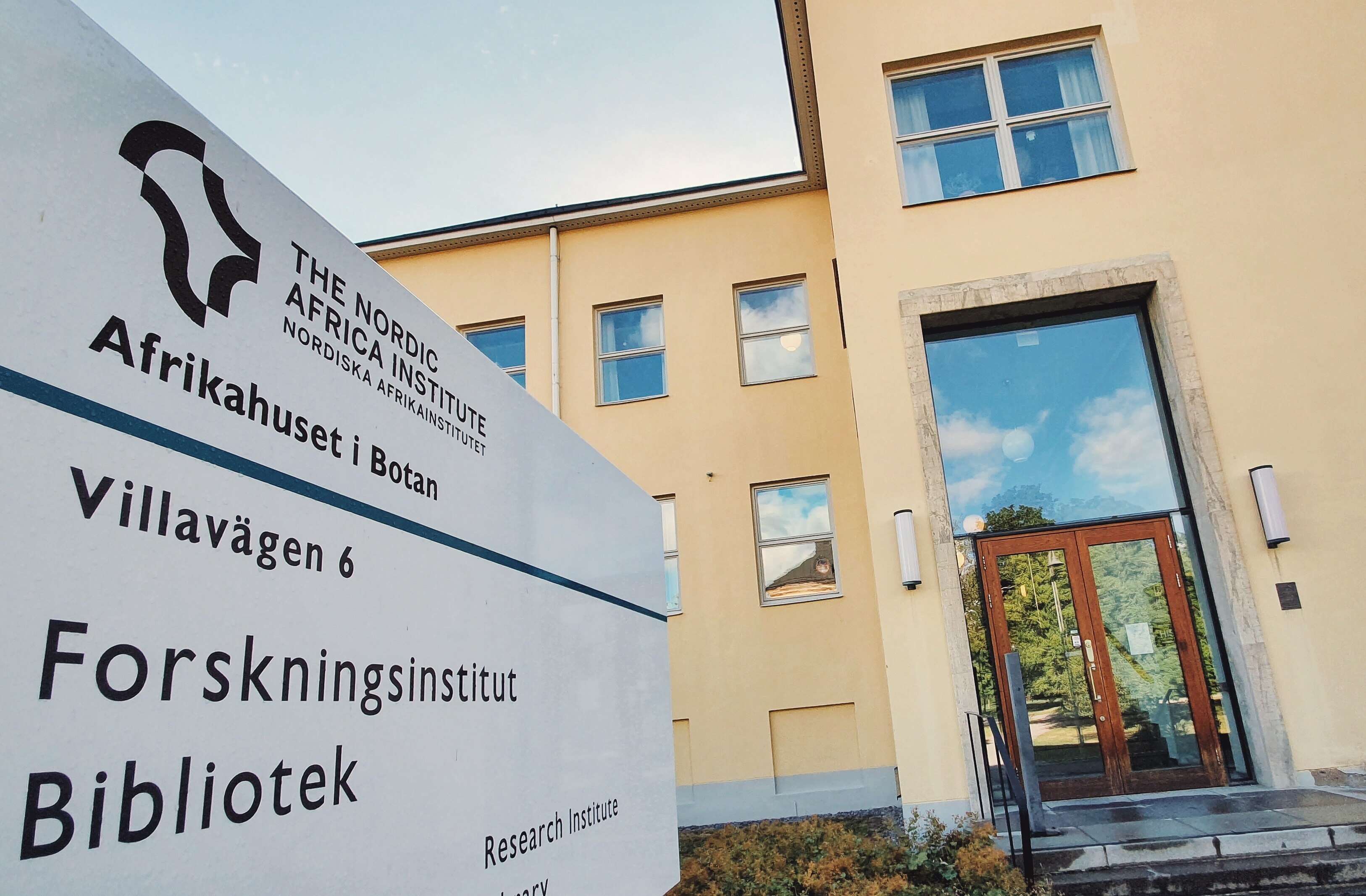
The Nordic Africa institute is a 60-year-old knowledge hub for collaborative research, library services and communication that supports a deeper understanding of contemporary African perspectives, challenges and opportunities. Located in Uppsala, Sweden the institute hosts both African and Nordic scholars. Here on the podcast you will have an opportunity to listen directly to our scholars as they deep dive into current events on the continent.